In (very) short
This research group is part of the Solid Mechanics Laboratory (LMS) under the auspices of the Centre national de la recherche scientifique (CNRS) and the Institut Polytechnique de Paris (IPP).
We focuses on the development of real-time digital twins for metal additive manufacturing. We adopt a multidisciplinary approach that combines thermal analysis, theoretical mechanics, computational materials science, neural networks, and experimental validation. Our primary goal is to develop computationally efficient simulation tools for additive manufacturing processes—particularly directed energy deposition. Such part-scale, rapid models enable the optimization of residual stress states and the design of targeted microstructures.
Additionally, the research group is oriented toward real-world applications such as part repair, embedding sensors within additively manufactured components, and advancing technologies that support low-carbon energy production.



Ongoing projects
EIC Pathfinder Open / FIBER3D
- Agency: European Innovation Council (EIC)
- Instrument: Pathfinder Open
- Project Leader: Daniel Weisz-Patrault
- Funds: 3,235,253€
- Start date: September 2026
- Partners: Sara Bagherifard (Politecnico di Milano), Roland Logé: (EPFL), Francesco Delloro (Mines Paris), Nazila Safari Yazd: (RISE), Kamil Kosiel (Łukasiewicz – Poznański Instytut Technologiczny), Robert Socha (CBRTP) and Patrizio Lomonaco
- Core scientific team: PhD, postdoc, and engineering positions will open soon
Multi-Process Strategy To Embed Optical Fibers In 3D-Printed Metal Parts (FIBER3D)
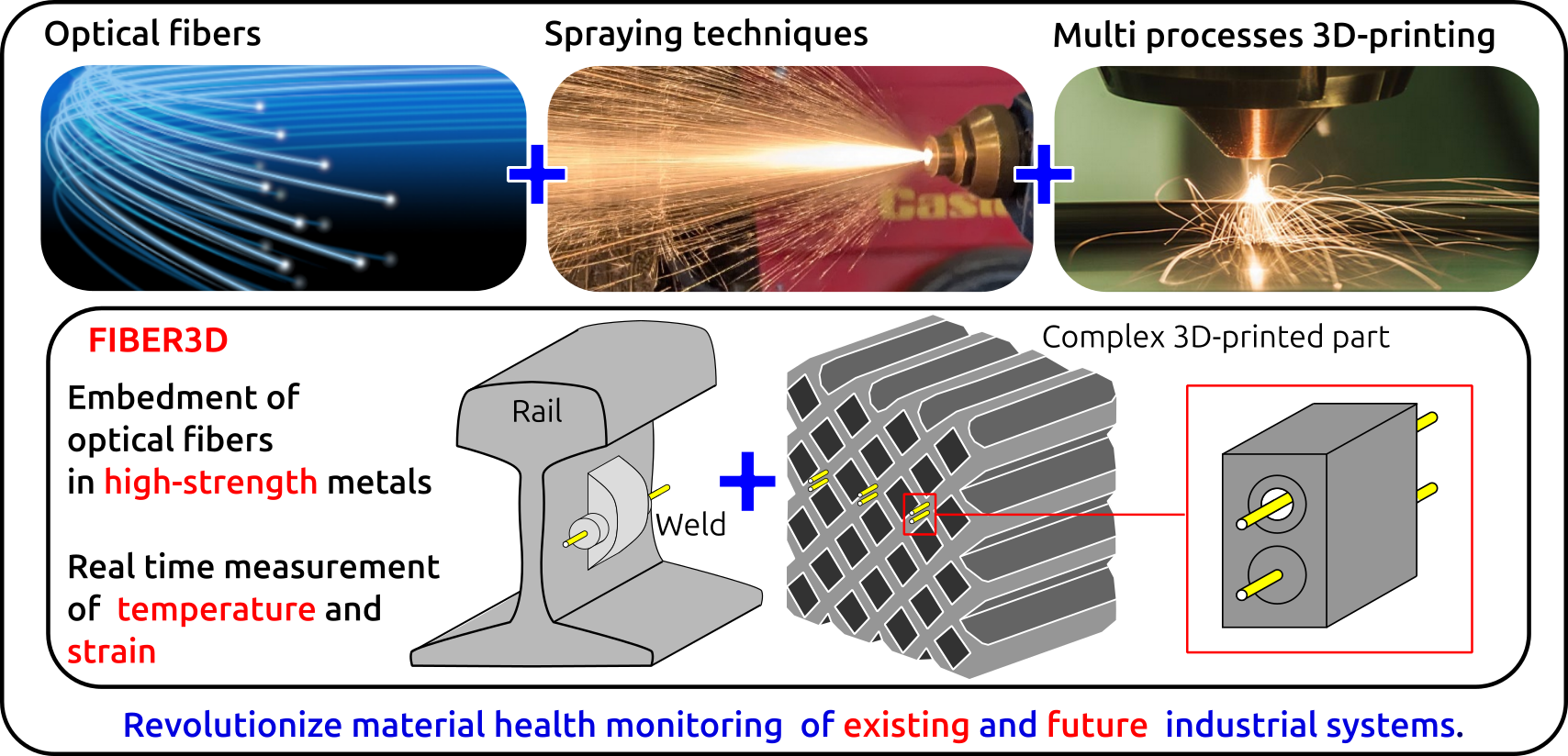
To meet low-carbon targets, Europe can rely on over 250,000 km of railway, 25,000 km of hydrogen pipelines, more than 100 nuclear power plants with complex piping systems, and emerging technologies like small modular reactors and advanced engines. However, intensified use of existing infrastructure and stringent design demands in new technologies make continuous material health monitoring essential. Yet, most critical parts are made of high-strength metals with high melting points, preventing direct sensor integration via welding or casting. FIBER3D proposes a groundbreaking fabrication technology that enables the production of sensors that can be directly welded onto existing surfaces or embedded within newly manufactured metal components. This is achieved by combining optical fiber sensors—capable of measuring temperature and strain along their length—with advanced spraying and 3D-printing techniques. The consortium, formed by world-leading experts in photonics, chemistry, materials science, metallurgy, thermo-mechanics, applied mathematics, and mechanical design, offers guarantees of success. FIBER3D’s technology can be applied across the entire existing Europe’s railway network, hydrogen transport systems, and nuclear infrastructure, as well as in 3D-printed parts for low-carbon technologies. This unique and transformative material health monitoring approach will significantly improve the sustainability, safety, and competitiveness of key industries by enabling real-time diagnostics and predictive maintenance, preventing catastrophic failures. FIBER3D will revolutionize material health monitoring in both existing and future industrial systems.

CIEDS grant / LIDRES
- Agency: Centre Interdisciplinaire d’Etudes pour la Défense et la Sécurité (CIEDS)
- Instrument: APP Vague 5
- Project Leader: Daniel Weisz-Patrault
- Funds: 486,040€
- Start date: October 2025
- Partners: Eric Charkaluk (IPP), Theo Zurcher (DGA)
- Core scientific team: L. Brencklé (Ph.D. student), M. Sazerat (Post-doc), L. Lesueur (Research Engineer), S. Leonardi (Research Engineer)
Control of Distortions and Residual Stresses for the Repair of Parts by Additive Manufacturing Using Directed Energy Deposition (LIDRES)
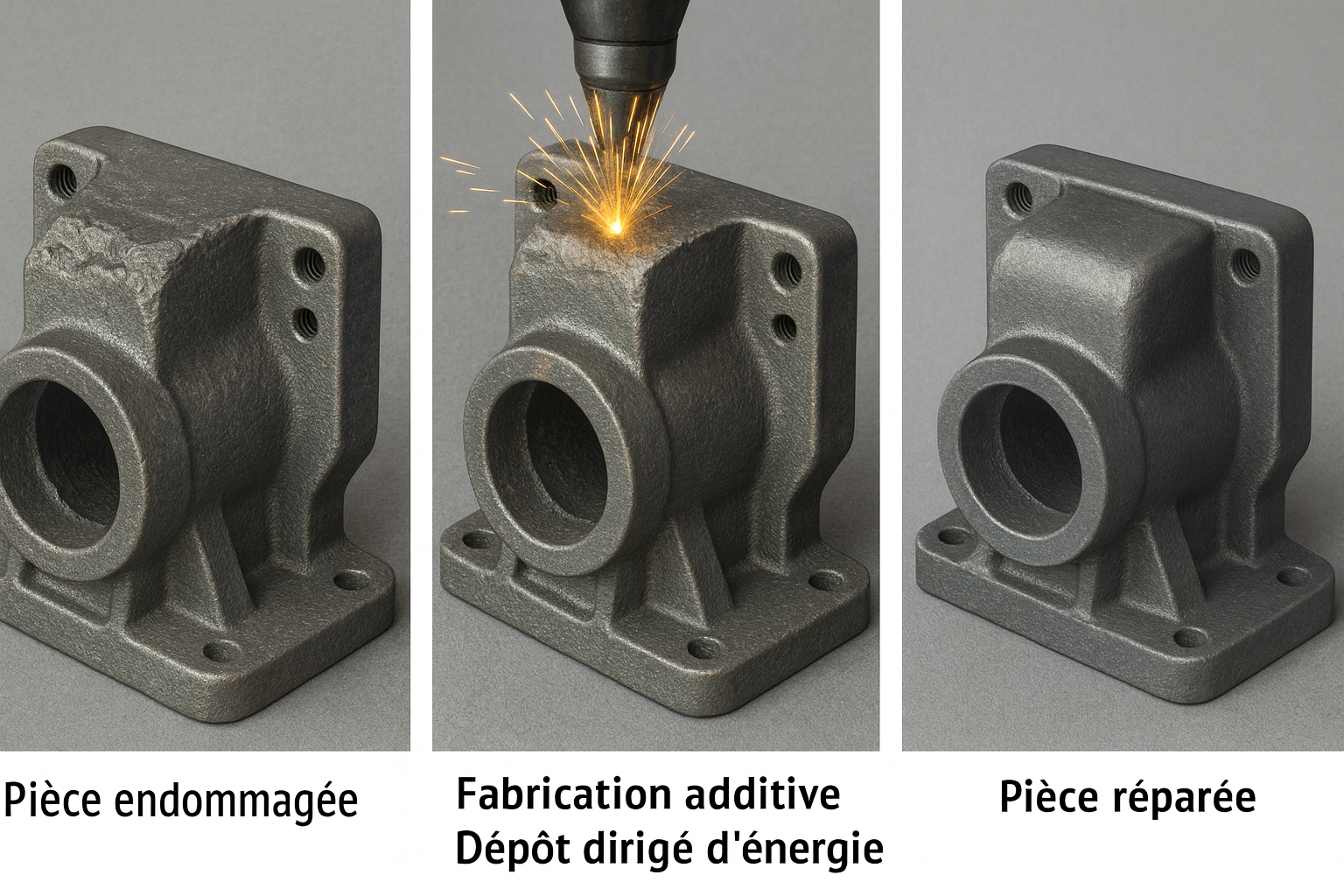
The objective of this project is to develop an experimentally validated optimization method, followed by a process control strategy, to correct distortions and reduce residual stresses during the repair of metal parts using laser directed energy deposition (L-DED) additive manufacturing. The optimization will rely on fast numerical models of the process, while the control strategy will be based on a neural network interpreting in-situ displacement measurements obtained through digital image correlation. The experiments will be conducted first on simple geometries with full-field measurements during the process, and then on geometries that are more representative of real applications.

CIEDS grant / LaserSurf
- Agency: Centre Interdisciplinaire d’Etudes pour la Défense et la Sécurité (CIEDS)
- Instrument: APP Vague 4
- Project Leader: Manas Upadhyay
- Funds: 699,712€
- Start date: October 2024
- Partners: Daniel Weisz-Patrault (CNRS, IPP)
- Core scientific team: T. Andrieux (Ph.D. student), A. Baganis (Post-doc)
Rapid laser surface treatment of printed metal parts to improve fatigue and wear resistance (LaserSurf)
The objective of this project is to develop and optimize a high-speed surface treatment using a micro-beam laser to improve the fatigue and wear resistance of metal parts produced by additive manufacturing. This process would replace the heat treatment and polishing currently required, reducing the cost, duration, and energy consumption of the finishing stage.